Po shfaqen postimet me emërtimin nitro harley. Shfaq të gjitha postimet
Po shfaqen postimet me emërtimin nitro harley. Shfaq të gjitha postimet
e diel, 28 mars 2010

e martë, 19 shkurt 2008
My Early Days of Fighting the Snake Wobbles

By Grandaddy Joe Smith, All Rights Reserved
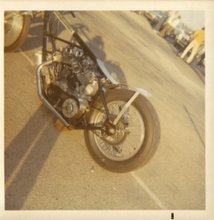
In the early days (1969) when I fell down at Irwindale Raceway in the lights due to a lock to lock wobble it was on the first Chassis I built. When the wobble started it was a slow kind of snake wobbling and then all of a sudden it was lock to lock. At the time I didn’t know the first thing about Rake and Trail and when I built the chassis I gave it a little more than stock rake. When I built the next chassis I bought a book on Motorcycle Frames and read about Rake and Trail, now that I knew what they mean I could understand the mistake I made on the first chassis.
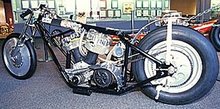
The next chassis I built had 7 ½ inches of trail, the rake was 43 degrees. At the time it was considered a space age designed but it still had those little snake wobbles. I went to Laid law’s Harley Davidson and borrowed the devise they used to spin the front wheel doing a wheel balance. I put the bike on a block of wood under the motor with just enough height for the front tire to clear the ground, spun the wheel as fast as the machine would spin it and turned the handlebars left and right and let go and the forks would come back to center, I tried every way I could to make it go into a wobble but it always returned to center. I spun it up again and went to the rear and gave the slick a slight slap on the sidewall and the thing almost fell off the block in a lock to lock wobble. I tighten the steering dampener like always thinking that would take care of it, spun it up again, gave the slick another little slap on the sidewall and it was worse. I took hold of the slick at the very back and moved the tire side to side slowly it would get that snake wobble. I started loosing the dampener until it was completely loose and lost the snake wobble. From then on the dampener was always loose; I eventually took it out of the neck.
It was right after that I was at the Harley Factory asking for a new truck and the President at the time was AMF, he came from Chrysler and while he went about getting me a truck he had someone take me to a meeting in the Engineer Department to get me out of his office. There were some pretty big guys sitting around this table including Dick O’Brian (racing Dept.). There were a lot of things being discussed and it came around to the Police Bike and its wobble problems. They discussed it for quite awhile and finally O’Brian looked at me and asks what I thought about the problem. He took me by surprise, but I knew he was trying to put me on the spot because some of my money came out of the Racing Department (most was from Advertisement) and he didn’t like it. So being the entertainer I am I stood up and begin talking.. “You Gentlemen know that the reason the Police Bike has a problem is simply because of the weight on the rear because of the Radio Boxes. They’re made out of steel, why don’t you make them out of Fiber Glass like your Saddle Bags and take that Dampener off the front forks and maybe your wobble problems will be on the way to being solved. Guess what?
The time I spent working in a Sailplane Company I learned some things that could be applied to building a chassis. The biggest thing I ever learned about curing wobbles came from there. They have there “Bench Racing” and one night I stayed to see what they talked about. During the conversation one of them ask me what kind of problems I face in the Drag Race world. I mention speed wobbles. He laughed a little and said we have our wobble problems too but it’s in the tail. He explained that when the Sailplane developed a tail wobble they try to correct it but they couldn’t move the stick the right direction fast enough to stop it, they just make it worse. They came up with the ideal of letting go of the stick and the tail stopped its wobble. He said he understood I couldn’t let go of the handlebars but maybe if you put even pressure forward with both hands it might work. On my singles even with the dampener out it had the snake wobbles occasionally but would stop on its own. When the next snake wobble started; I push forward with even pressure with both hands and the snake stop sooner.
I felt that what started the wobbles was the slick would get hooked up at growth and did what I called “begin to walk on the side walls” which cause the rear section to make the chassis pivot on the bottom bearing of the fork stem and if the dampener was tight enough it would work its way to the forks instead of staying there on the bearing.
The year I went to Bonneville I put those small dampener’s on that went from the frame to the forks and every run I made I had to shut down because of wobbles that started every time I shift gears. I took them off and It solved my wobble problems.
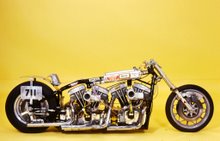
Every good run I made with my Double Engine Top Fuel Harley would get that snake wobble every time I shifted into high gear and I stopped everyone with that “push forward with even pressure with both hands”.
I’M NOT SAYING THAT YOU SHOULD DEPEND ON THAT WORKING ON YOUR BIKE. I’M JUST SAYING THAT’S HOW I LEARNED SOME IMPORTANT THINGS ABOUT BUILDING A CHASSIS IN THE EARLY DAYS. BUT IF YOU GET THE OLD SNAKE, GIVE IT A TRY...
e hënë, 23 korrik 2007
From Kick Start to Bump Start to Rollers To Tow Start To The Electric Starter
 When I first started drag racing I started my motor with the kick starter on the transmission. It was always hard to start because of different engine timing, smaller batteries and ignition distributor locked in position. We also went through a period of what they called bump start, that's where one or two people push you by hand and you rise up on the rear pegs and throw your weight toward the seat and let out the clutch.
When my motor got bigger in cubic inches and piston compression went up it was impossible to kick start or bump start any longer. Now I have to hold on to the door handle of the truck with my right hand and the truck pulls me up to speed (about 35 MPH) I let go and let out the clutch and the motor starts and is ready to go about the task of making a run down the drag strip. This was done at all drag strips and it was called the fire up road.
A lot of years went by using the fire up road and the NHRA decided it was getting to dangerous because some times the Dragsters and Funny Cars fired there Engines right in front of the spectator stands and it was taking up to much time with so many entries, as Drag Racing is a popular sport and has many Spectators at NHRA Events.
As the years progressed the Cars with Blowers were already changing to hand held starters to start there engines, this worked well on cars with blowers because of the very low Compression Ratio they ran.
The Rollers were the next advancement in starting Dragsters and Funny Cars and the bikes were allowed to use these rollers. They were positioned right behind the starting line and speeded up the races. I always like the rollers; it brought a lot of excitement right there to the starting line, for the racers and the spectators.
And then we got the big announcement from NHRA. The rollers will be done away with and all Entries must have there own starters. Most of the Dragsters, Funny Cars and other Automotive had already been making the switch. That left all Motorcycles that relied on something to start there motors with a new situation. It took awhile for someone to make one that worked, the motorcycles compression was so high that the starters they first tried were having a hard time doing the job, but with some gear reduction they came up with a good starter.
I took my double to an Automotive Shop that made starters for the cars. I ask him if he could make me a starter that would work on my bike. He gave me the parts I would have to install on the bike for the starter, said come back next week and pick up your starter.
The following week I returned and he was going to show me how to use it. He had one battery hooked to the starter, hooked it on the parts I installed per his instructions, hit the starter button and smoke came from the start. He said we are going to need more battery. He fixes the starter with another starter motor and hooked it to three batteries, connected it to the double, hit the start button and smoke came from the starter. By this point he's getting frustrated. Ask me what the compression was on the motors, 10.4 to 1. Well no wonder it won't work. Give me a couple weeks and I will figure something out, it will be different than any thing out there, but I don't know quite what it will be like yet.
It was actually a month before he called me. When I got there, he pointed over to this thing on the floor and said there's your starter. It was the drive motor out of an Electric Golf Cart. I went over and looked down; it was almost as big as one of the motors in the bike. It had a handle on it, I picked it up and said WOW, what does this thing weight, 90 pounds he says with a big grin on his face. I told him there was no way my Family could handle that on the starting line, its way too heavy. He told me it's that or no starter and he wasn't sure it would do the trick until we try it, you will have to build something with wheels on it to put the starter in and roll it right up to the mounting bracket.
We started with one battery with the Spark Plugs out of the motors, it turned over great. Put the plugs back in and tried it again, it went up to the compression stroke and stopped, he let off the switch right away so not to burn the thing up. We spent most of the day trying different things, ended up with four batteries and he felt that wasn't enough. We tried the batteries in different wiring series and found the best was one big battery.
I did build a special little cart with wheels for the starter, it worked out better than I thought, and it also took place of the block of wood I used to hold up the bike in the pits. It was hard for the family to put back into the truck, I usually had it all hooked up and ready to start and one of the family disconnected it and it took two of them to put it back in the truck. I did have to use five pretty large truck batteries that I built a special compartment for in the back of the truck and fifteen foot cables with quick connect and disconnect ends. The Batteries had to have a full charge before every day of racing. I carried a thirty amp charger for that, and ran a cable from the Motel Room or an outlet on some post in the parting lot. Sometimes it was a hassle.
I always had a big half inch ratchet lying on the ground by the starter; some times I would have to turn the motor past the compression stroke so the starter would work. It was a lot of trouble to use but it became one of the big attraction at the drags, spectators were sometimes standing around to watch me fire the motors just to see that starter. The NHRA liked it so much that when I did my Exhibitions at the Nationals they had me take every thing right out on the starting line to fire up for the run, while talking about that starter.
Joe Smith - All Rights Reserved
e premte, 22 qershor 2007
1971 Breaking The 9 Second Barrier

1971 The 13th Annual Fuel and Gas Championships
Formosa Raceway, Bakersfield, California
By Joe Smith
Before I start this story I should tell you about “the end to the tire smoking runs”. (Tire smoke runs were in the 9:30 E.T. and about 164 MPH range). I had found out during the tire smoking days just how to make a run smoking the tire and get the most traction. I had to let the clutch out first and open the throttle afterwards, it had to be timed just right to stay under the power, still smoke the tire and not stall the engine. When I learned how to do this right it gave me an edge over the other fuel bikes. One Saturday night at Irwindale Raceway while making a single run I was a little late with the throttle and the engine bogged off the starting line, I left the throttle on and finished the run. I’m sitting on the bike taking off my helmet and gloves and feeling a little disgusted. The tow truck is coming down the return road with the head lights flashing off and on, pulls up with the brakes locked and the tires screeching. My wife says you just turned your quickest run ever, 9:08, 168.00 MPH”. That Saturday night was the end to tire smoking runs. I killed the engine a few times on the starting line until I learned how to do it right.
It was Saturday night at Irwindale Raceway and Mel Rex; the general manager had talked me into running in a bracket race. I had never been in a bracket race before, that was really a car thing. Well, I was still trying to collect points with Mel and Irwindale Raceway so I had said OK. I ran three times in handicap races. The first one was against a Super Stock of some kind and of course he got a big head start on me before I got my green light. I just did nip him at the traps and won with a 9:20, 163.35 MPH. In the pits I checked the bike over and my wife mixed up the next batch of fuel and we went over to the In & Out hamburger stand to get something to eat and while we were in line the guy behind me comments it was neat seeing my bike in the brackets, but look out if you have to race something fast with a chute.
The next round I ran against another slower car, he got a head start and again I just did get him in the lights. The run produced a 9:16, 160.98 MPH. We get back to the pits and I tell my wife, this is not a lot of fun and I’m not doing it again. The last round is against a Fuel Altered, it wasn’t “Willy Borsch” but it was still a really fast and wild car to race. This time I get the head start and I’m really hooked up good. I get right to the timing light and this Fuel Altered zooms by and his chute pops open right beside me. There’s a loud bang and the concussion from the chute blew my bike toward the guard rail. It causes me to close and open the throttle so fast that I blew an engine and darn near fell down. About the only thing left in the frame was the heads hanging on the top bracket and the crankcases bolted in the frame. I gathered all the parts and headed for home.
The really bad thing was the next weekend is the race at Bakersfield, California. I wouldn’t have time to get any new parts.
The next morning I go out to the garage and start looking for parts I can put another engine together with. I checked out the parts that was in the engine I blew and find the only thing left I can use is the cylinders and the rear one has a deep scratch in it. The heads have a bent valve in each and the exhaust pipe bolt threads are gone but I can take care of the heads. The rear rod is bent and I will have to do some welding on the crankcase to repair a couple cylinder studs and a broken front motor mount. It ends up that I need fly wheels, rods, and pistons and I’m back in business. It just happens; I have a set of 4 ¾”. Stroke S&S flywheels I was going to use later, but the only pistons I have are for a 4 ½ in stroke. I have a set of used pistons that Venolia gave me to set up for the 4 ¾” stroke but they are in pretty bad shape and instead of the eight thousand clearance I normally use I will have to settle for eleven thousand clearance I burned a lot of midnight oil and by Thursday night I had the bike back together (now a 108 cubic inch) and ready to run; with a lot of junk parts. I didn’t even have time to clean up the welding I did on the crank cases and frame. But, I was going to Bakersfield.
The Fuel and Gas Championships was one of the most popular Drag Races their was on the West coast, all the big name Fuel Dragsters were there and it never failed to be a great couple days of Drag Racing. We got there Friday morning and found a Motel that still had a room left. Checked in, unloaded the baggage and headed for the drag strip. The place was already pack, took an hour to register and almost as long to fine a place to pit. Unloaded the bike and went though a final check on everything. My wife Pat made a fuel mix and set it a side to put in the tanks when we got closer to running. The line the fuel cars used that led to the fire up road was long. It wound its way clear through the pits. The bikes had a special place next to that line, but you still had to wait a long time to make a run. (I got one run that day).
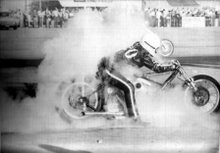
We got close to the time to make our run, Pat check the fuel mix and filled the tanks. We had moved up from our normal 86% to 89% nitro and I had upped the jets to .512 because of the 3% more nitro. This is the first time I fired the bike with the bigger engine and the minute it lit I knew it was stronger. I got a good burn out, cracked the throttle a couple times and staged. I got the green light and worked the clutch and throttle just like I did with the 102 cubic inch engine, carried the front wheel about fifty feet, got a little front end wobble but it straighten out and the engine quit about the middle timing light. When Pat came down to pick me up, she said it sure sounded like a different bike but sounded like you ran out of gear or something, but you ran a good number, 9:12 E.T., 163.82 MPH. I said it quit in the middle of the timing lights and we got a fuel leak because my leg is soaked with nitro. We got back to the pits and looked all over for a fuel leak but couldn’t fine one. There was no time left in the day for another run, so we loafed around awhile and watched the dragsters make some runs and went back to the Motel.
Of course the parties were in full force that night and most of the racers were working on their machines in the parking lot, including me. I found one thing I forgot to do, when I changed to the .512 jet I forgot to change the fuel nozzle, the one I had in was smaller than the jet, it was the one I used when I was running 86%. I changed it that night, and left the fuel leak for day light. After all there was some partying to do.
Saturday, it took a long time getting to a pit parking spot, this time Big Daddy Don Garlits was just down the line from where we were pitted. There was a place for the bikes to pit, but it was always full (the best spots taken) so I sometimes pitted with the dragsters. No one ever complained. We decided to fire the bike and look for the fuel leak. We had to go to the end of the strip on the return road, fire the bike and ride it back to the pits. By the time I got back my leg was soaked with nitro again. I put the bike on a block and let it set there idling and begin looking for a leak. I couldn’t believe where it was coming from, it was squirting a stream out from between the rear cylinder and the head. (I later found one head bolt was about .010 to long and the head did not seal off the O-ring because of that bolt). My wife said, I guess were done. No were not, I got a long narrow center punch and begin tapping around the area where it was leaking until it quit, it held all weekend.
I hung back for quite awhile that day. I had fixed a fuel leak I wasn’t sure was fixed, was using junk engine parts and had no trial run on the fuel and jet change. Pat mixed the fuel and we got in line and waited our turn. I was sitting on the bike waiting for the OK to start the run, got the wave to go a head, grabbed the door handle and when the tow truck reached the right speed, let go and let out the clutch and the engine fire right away. It was so responsive to the throttle I couldn’t believe it. Made a good burn out behind the truck, got staged and got the green light. The rear tire hazing a little smoke for a few feet and the front wheel about two inches off the ground, it stayed that way for about half the track. I had a little front fork wobble, cleared the timing lights and made my way to the return road. I knew it was a good run but didn’t know how good it was.
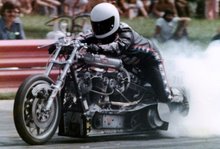
Here comes the tow truck with the head lights flashing off and on and the horn blaring away. I did it, the first 8 second run, 8:97 E.T., 166.05 MPH.
The best part of that run was the tow back to the pits. Going back to my pit area you had to drive along the line (that weaved its way through the pits) of fuel cars waiting to make a run. The announcer was still talking about “The First Eight Second Run” by a motorcycle and all the racers in that line was clapping as we drove past. The NHRA wasn’t sanctioning record runs for motorcycles at this race but because it was “The Gas and Fuel Championships” it recognized my 8:97 as the first.
Sunday was race day. My first run was against Bob Abel and his Harley who blew his engine on Saturday and was running his back up. I took the win with 9:16 E.T., 165.89 MPH. The second run was with Jeff Gough and his Sportster. I had a good burn out and pulled a big wheel stand right off the line, got a little crossed up and had to shut down to gain control but still got the win light with a 9:33 E.T., 152.60 MPH. The third and final run was against Boris Murray and his twin engine Triumph. We both fired together down the fire up road ready to run. What a different between the two bikes. Boris has to keep throttling the twin and my Harley idles until I leave the starting line. I got a good green light, was carrying the front wheel again and felt I was on the way to another run in the eights. While the front wheel was in the air I got a little crossed up and had to back down on the throttle, got the wheel down and back in control in time to still turn a 9:22 E.T., 160.05 MPH for a win. In the years to follow Boris and I would battle each other for wins and records all over the country. He was a great rider and competitor.
In all the years of Drag Racing you always remember some races more than others. That weekend at the Gas and Fuel Championships” in Formosa, California was one of those races. It was the race that got my racing career off to a good start. A Sponsor Program from Harley Davidson and the beginning of the Exhibition Runs at all the NHRA Nationals.
Back at the Motel the first thing I did was to call Bob Laidlaw. (Laidlaws Harley Davidson) I woke him up and told him about the first 8 second run; we talked about thirty minutes, I filled him in on ever thing that happened over the weekend. After all, he was my Sponsor at the time.
Joe Smith
Top Fuel Harley Racer
All Rights Reserved - Joe Smith


Abonohu te:
Postimet (Atom)