e shtunë, 14 korrik 2007

Pete Jackson Injectors


Pete Jackson Injectors

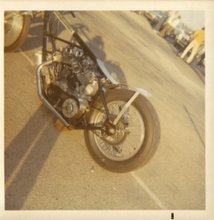
Not many people knew that I was contracted to Harley Davidson Motor Company ten months a year from 1971 through 1977. Dick O'Brian, head of the Racing Department at HD was good friends with Pete Jackson Injectors, out in California and Dick set up a deal with Pete to work with me on putting an injector on my Drag Bike.

After meeting with Pete Jackson a couple times we came to the conclusion that we needed an injector body on each head. He was going to build the set up, flow test it for my 102 inch motor and I had to do the installing.
I'm setting in my shop thinking about how I was going to change each intake port to handle a single mount for the injector. I know it requires cutting, welding and porting for each head because that’s how I did it for my Knucklehead motor. I hated to ruin a couple good heads for something that may not work and I thought about it for a couple weeks.

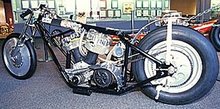
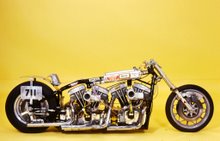
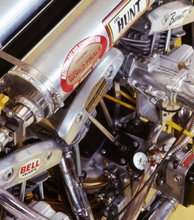
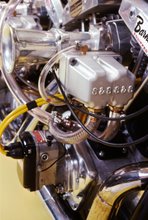
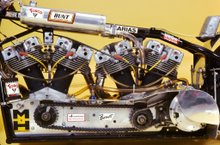
I had taken the heads off and was sitting there looking at the cylinders and I came up with the ideal of using two rear cylinders, the one on the front I turned 180 degrees so the head would fit on with the intake port sticking out the left side, turn the rocker box back 180 degrees and see if it will fit and with a little grinding for clearance and a couple weekends to look at it and think about it that’s just what I did. Every thing fit perfect. I mounted the injector body’s right to the head with a clamp like you would the intake manifold. I ran the fuel pump off a belt, set up from a pulley that went on the outside of the motor sprocket and made a fuel tank that mounted to the two down tubes in the front of the frame. After doing the pluming it was ready for some test runs. With the injectors on that way it reminded you of a Vincent Motorcycle.

I decided to take it to Fontana Raceway on Saturday night. Pete had explained every thing to me about how the barrel valve works an about the jet working back words. When I got to Fontana it attracted a lot of attention because of the different setup. My wife Pat made a mix, 86 percent, filled the tank and we went to the return road to fire it up. It fired up right away; the idle was a lot different than with carburetors. It sounded more like an injected small block Chevy. I messed with that darn thing all night, trying to get the right barrel valve adjustment and jet change, never did get a run. I went back to Pete, told him what was happening.and he did another flow test on it and gave me a different pump to run.

Back to Fontana the next Satuday night, it was a lot better and I did make some runs but I had to use a lot of throttle off the line and it kept going up in smoke, top end wasn't too bad, over 160 MPH. Back to Pete and told him what was happening. He made three barrel valve inner sleeve with different V-ramps (he called them) that controlled the fuel right off idle.

I made so many changes that Saturday night I was ready to give up. This time I called Pete and talked him into coming to Fontana next Saturday night.

I took my other race bike, King Rat along. When Pete got there we fire the injected bike and he messed with it a little and got it sounding better than I had. I told him I was going to make a run on my other bike first. We had been out there so much the last three or four weekends that when they seen I was making a run on King Rat they really started talking it up on the loud speaker, the fence was lined with spectators. I got a good run carrying the front wheel, the spectators always loved when you did that. I ran 9.09 ET at 167.00 MPH. When I got back to the pits, Pete Jackson said; if you expect to come off the line at an idle with the injectors like you do with the carburetors, forget it, they won't do that.

I tried one more Saturday night. This time I took some files and I filed on those V-Ramps myself and before the night was over after making a couple test runs, I finally got one good run. I ran 9.12 ET, 166.82 MPH but the motor blew just as I was crossing the last timing light.

In my injector experience, I should have use a front rocker box and rocker arms instead of a rear on the front cylinder. I found out later that they are not interchangeable and the injectors on each head were too much power for the four inch tire we had to use. I always wanted to try it again when we were able to get a better tire, but other things seemed to always get in the way.

I can't remember the guy's last name, Jerry I believe was his first name, and he owned some kind of engine building place in Pomona CA. He had bought or some how had the (twin engine) Freight Train Dragster, and we use to joke about trading rides. Jerry had just made a run and was down at the end of the track and watched me get control and not fall down, when I got off the strip I pulled up behind his car. I took off my helmet and said to him, "this would be a good night for that trade because you won’t have to ride the bike". Later back in the pits he walked up to me, handed me his fire suit and said OK come on. I guess he felt pretty safe because it was the night the car only had one engine in it, doing some testing. They took me to the return road out of the way to get the feel of things, made a couple almost burnouts and he talked to me about how you shifted the trans (two speed), it was a lever close to the steering column, you pulled out. At Fontana in those days the dragsters fire up by being towed from the end of the strip, made a u-turn behind the starting line, made there burn out and staged. The anounser was really talking it up about me driving the dragster. Every thing went pretty good and I made a good burn out. They did have to push me back to restage after I rolled past the lights a couple times, got the green and was way out in front of the other dragster and had trouble making the gear change, finally got it in gear but the other Dragster had already past me. When Jerry came to pick me up, he was excited about how I got such a hole shot on the other car. I told him I did just like my bike, let the clutch out first and follow up with the throttle. I only drove that one time, it was an experience. Jerry ask that night if I wanted to start driving for him, of course I turned it down, I already had a ride.


By Granddaddy Joe Smith
All Rights Reserved - Joe Smith

e premte, 22 qershor 2007

1971 Breaking The 9 Second Barrier


1971 The 13th Annual Fuel and Gas Championships
Formosa Raceway, Bakersfield, California

By Joe Smith

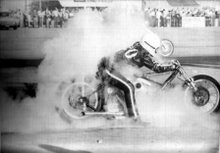
Before I start this story I should tell you about “the end to the tire smoking runs”. (Tire smoke runs were in the 9:30 E.T. and about 164 MPH range). I had found out during the tire smoking days just how to make a run smoking the tire and get the most traction. I had to let the clutch out first and open the throttle afterwards, it had to be timed just right to stay under the power, still smoke the tire and not stall the engine. When I learned how to do this right it gave me an edge over the other fuel bikes. One Saturday night at Irwindale Raceway while making a single run I was a little late with the throttle and the engine bogged off the starting line, I left the throttle on and finished the run. I’m sitting on the bike taking off my helmet and gloves and feeling a little disgusted. The tow truck is coming down the return road with the head lights flashing off and on, pulls up with the brakes locked and the tires screeching. My wife says you just turned your quickest run ever, 9:08, 168.00 MPH”. That Saturday night was the end to tire smoking runs. I killed the engine a few times on the starting line until I learned how to do it right.

It was Saturday night at Irwindale Raceway and Mel Rex; the general manager had talked me into running in a bracket race. I had never been in a bracket race before, that was really a car thing. Well, I was still trying to collect points with Mel and Irwindale Raceway so I had said OK. I ran three times in handicap races. The first one was against a Super Stock of some kind and of course he got a big head start on me before I got my green light. I just did nip him at the traps and won with a 9:20, 163.35 MPH. In the pits I checked the bike over and my wife mixed up the next batch of fuel and we went over to the In & Out hamburger stand to get something to eat and while we were in line the guy behind me comments it was neat seeing my bike in the brackets, but look out if you have to race something fast with a chute.

The next round I ran against another slower car, he got a head start and again I just did get him in the lights. The run produced a 9:16, 160.98 MPH. We get back to the pits and I tell my wife, this is not a lot of fun and I’m not doing it again. The last round is against a Fuel Altered, it wasn’t “Willy Borsch” but it was still a really fast and wild car to race. This time I get the head start and I’m really hooked up good. I get right to the timing light and this Fuel Altered zooms by and his chute pops open right beside me. There’s a loud bang and the concussion from the chute blew my bike toward the guard rail. It causes me to close and open the throttle so fast that I blew an engine and darn near fell down. About the only thing left in the frame was the heads hanging on the top bracket and the crankcases bolted in the frame. I gathered all the parts and headed for home.

The really bad thing was the next weekend is the race at Bakersfield, California. I wouldn’t have time to get any new parts.

The next morning I go out to the garage and start looking for parts I can put another engine together with. I checked out the parts that was in the engine I blew and find the only thing left I can use is the cylinders and the rear one has a deep scratch in it. The heads have a bent valve in each and the exhaust pipe bolt threads are gone but I can take care of the heads. The rear rod is bent and I will have to do some welding on the crankcase to repair a couple cylinder studs and a broken front motor mount. It ends up that I need fly wheels, rods, and pistons and I’m back in business. It just happens; I have a set of 4 ¾”. Stroke S&S flywheels I was going to use later, but the only pistons I have are for a 4 ½ in stroke. I have a set of used pistons that Venolia gave me to set up for the 4 ¾” stroke but they are in pretty bad shape and instead of the eight thousand clearance I normally use I will have to settle for eleven thousand clearance I burned a lot of midnight oil and by Thursday night I had the bike back together (now a 108 cubic inch) and ready to run; with a lot of junk parts. I didn’t even have time to clean up the welding I did on the crank cases and frame. But, I was going to Bakersfield.

The Fuel and Gas Championships was one of the most popular Drag Races their was on the West coast, all the big name Fuel Dragsters were there and it never failed to be a great couple days of Drag Racing. We got there Friday morning and found a Motel that still had a room left. Checked in, unloaded the baggage and headed for the drag strip. The place was already pack, took an hour to register and almost as long to fine a place to pit. Unloaded the bike and went though a final check on everything. My wife Pat made a fuel mix and set it a side to put in the tanks when we got closer to running. The line the fuel cars used that led to the fire up road was long. It wound its way clear through the pits. The bikes had a special place next to that line, but you still had to wait a long time to make a run. (I got one run that day).

We got close to the time to make our run, Pat check the fuel mix and filled the tanks. We had moved up from our normal 86% to 89% nitro and I had upped the jets to .512 because of the 3% more nitro. This is the first time I fired the bike with the bigger engine and the minute it lit I knew it was stronger. I got a good burn out, cracked the throttle a couple times and staged. I got the green light and worked the clutch and throttle just like I did with the 102 cubic inch engine, carried the front wheel about fifty feet, got a little front end wobble but it straighten out and the engine quit about the middle timing light. When Pat came down to pick me up, she said it sure sounded like a different bike but sounded like you ran out of gear or something, but you ran a good number, 9:12 E.T., 163.82 MPH. I said it quit in the middle of the timing lights and we got a fuel leak because my leg is soaked with nitro. We got back to the pits and looked all over for a fuel leak but couldn’t fine one. There was no time left in the day for another run, so we loafed around awhile and watched the dragsters make some runs and went back to the Motel.

Of course the parties were in full force that night and most of the racers were working on their machines in the parking lot, including me. I found one thing I forgot to do, when I changed to the .512 jet I forgot to change the fuel nozzle, the one I had in was smaller than the jet, it was the one I used when I was running 86%. I changed it that night, and left the fuel leak for day light. After all there was some partying to do.

Saturday, it took a long time getting to a pit parking spot, this time Big Daddy Don Garlits was just down the line from where we were pitted. There was a place for the bikes to pit, but it was always full (the best spots taken) so I sometimes pitted with the dragsters. No one ever complained. We decided to fire the bike and look for the fuel leak. We had to go to the end of the strip on the return road, fire the bike and ride it back to the pits. By the time I got back my leg was soaked with nitro again. I put the bike on a block and let it set there idling and begin looking for a leak. I couldn’t believe where it was coming from, it was squirting a stream out from between the rear cylinder and the head. (I later found one head bolt was about .010 to long and the head did not seal off the O-ring because of that bolt). My wife said, I guess were done. No were not, I got a long narrow center punch and begin tapping around the area where it was leaking until it quit, it held all weekend.

I hung back for quite awhile that day. I had fixed a fuel leak I wasn’t sure was fixed, was using junk engine parts and had no trial run on the fuel and jet change. Pat mixed the fuel and we got in line and waited our turn. I was sitting on the bike waiting for the OK to start the run, got the wave to go a head, grabbed the door handle and when the tow truck reached the right speed, let go and let out the clutch and the engine fire right away. It was so responsive to the throttle I couldn’t believe it. Made a good burn out behind the truck, got staged and got the green light. The rear tire hazing a little smoke for a few feet and the front wheel about two inches off the ground, it stayed that way for about half the track. I had a little front fork wobble, cleared the timing lights and made my way to the return road. I knew it was a good run but didn’t know how good it was.

Here comes the tow truck with the head lights flashing off and on and the horn blaring away. I did it, the first 8 second run, 8:97 E.T., 166.05 MPH.

The best part of that run was the tow back to the pits. Going back to my pit area you had to drive along the line (that weaved its way through the pits) of fuel cars waiting to make a run. The announcer was still talking about “The First Eight Second Run” by a motorcycle and all the racers in that line was clapping as we drove past. The NHRA wasn’t sanctioning record runs for motorcycles at this race but because it was “The Gas and Fuel Championships” it recognized my 8:97 as the first.

Sunday was race day. My first run was against Bob Abel and his Harley who blew his engine on Saturday and was running his back up. I took the win with 9:16 E.T., 165.89 MPH. The second run was with Jeff Gough and his Sportster. I had a good burn out and pulled a big wheel stand right off the line, got a little crossed up and had to shut down to gain control but still got the win light with a 9:33 E.T., 152.60 MPH. The third and final run was against Boris Murray and his twin engine Triumph. We both fired together down the fire up road ready to run. What a different between the two bikes. Boris has to keep throttling the twin and my Harley idles until I leave the starting line. I got a good green light, was carrying the front wheel again and felt I was on the way to another run in the eights. While the front wheel was in the air I got a little crossed up and had to back down on the throttle, got the wheel down and back in control in time to still turn a 9:22 E.T., 160.05 MPH for a win. In the years to follow Boris and I would battle each other for wins and records all over the country. He was a great rider and competitor.

In all the years of Drag Racing you always remember some races more than others. That weekend at the Gas and Fuel Championships” in Formosa, California was one of those races. It was the race that got my racing career off to a good start. A Sponsor Program from Harley Davidson and the beginning of the Exhibition Runs at all the NHRA Nationals.

Back at the Motel the first thing I did was to call Bob Laidlaw. (Laidlaws Harley Davidson) I woke him up and told him about the first 8 second run; we talked about thirty minutes, I filled him in on ever thing that happened over the weekend. After all, he was my Sponsor at the time.

Joe Smith
Top Fuel Harley Racer
All Rights Reserved - Joe Smith

Locations of visitors to this page

Website Design & Layout
By Smith Racing

e enjte, 21 qershor 2007

NHRA National Dragster Article

National Dragster, October 1971

One of the most outstanding features of organized drag racing has be its willingness to open up to new and unique forms of quarter mile competition. The advent of the fuel burning Funny Cars in the mid-1960’s and the introduction of Pro Stock in 1970 have both been major shot in the arms for the sport and the latest form of competition, Fuel Bike Eliminator, apparently is on its way to carving a permanent place in drag racing's spectrum for itself.

Fittingly, National DRAGSTER has chosen to single out the man who has furthered the cause of this unique breed more than anyone else with the first ever PROfile feature on a motorcycle racer. Joe Smith is the man’s name, and anyone familiar with the fuel burning two wheelers will surely back up its selection .Having been the first rider to put one of the dare devilish machines into the eights as well as the current NHRA Nationals Champion, Smith’s strangle hold on the bracket’s top billing was even further strengthened when it was made known that the Indy runner up, Jim Cook was riding a Joe Smith built bike. Smith’s two wheel racing career dates back to 1956 when he teamed with Clem Johnson, now of “Barn Job” fame, and by 1958, he held just about every strip record for gasoline powered bikes, hitting low eleven second elapsed times at over 123 MPH with regularity. Later on in the year, however, he retired from active racing and went to work as a carpet layer and then moved on to construction sail planes. Late in 1964, he took his newly purchased Chevelle out to Fontana for a bit of competition class and the act of renewed quarter mile competition lured him back to bike racing.

He built a bike identical to his 1958 model and unfortunately discovered that it ran no quicker than its predecessor---being considerably obsolete when compared to the present day models. Starting out again from scratch, he had a new frame completed eight months later, featuring a 102 inch motor, considerably bigger than the former 80 inch model. In 1966, the big change to fuel came and soon he was approaching the low nines’s. Then in 1967, nearly tragedy struck at Irwindale Raceway when he encountered a frantic speed wobble on the top end and fell off of the bike, sliding through on his back and tripping the timers a 9.82, 142 MPH. Not only did he break a collarbone and encounter painful skin scraping on his back, but he toyed with the idea of retiring and finding another rider. Four months later, however, he was back at it again, and in 1969 he utilized aircraft construction techniques to build a second frame, this on being far more sophisticated than the original.

In 1970, he and several other die-hard bike racers enjoyed a dream come true when a Bike Eliminator Program was initiated at the NHRA Nationals. Unfortunately, he went out in the first round to Doug Gall, whom he had just loaned one of his clutches only moments earlier.

The embarrassment was soon atoned for as in 1971 he recorded the sport’s first official 8 second bike elapsed time and used his “second chance” at Indy to blitz the field with multiple 8 second blasts beating his own “teammate” Jim Cook in the final for what has to be regarded as a most thorough “total” victory.

Now employed by Harley Davidson, Smith also been to able procure sponsorship from the motorcycle manufacturer, enabling him to concentrate all of his efforts on the furthering of his chosen breed’s status.

Having been informally “elected” as the spokesman or ambassador for the two wheeled clan, Smith is now working with Hays clutches on a new slipper model and with Marv Rifchin at M&H for new tires that will assist in the tricky operation of getting the sometimes unstable machines off the line with consistent performance. Other modifications to his bike will be a new full bodied fairing, which should aid streamlining and aerodynamic characteristics considerably.

How fast will the bikes be going a year from now? “We’ll be hitting maybe 180 MPH by this time next season”. Smith predicts, “Since Boris Murray (whom he regards as his toughest competitor) has already hit 174 and Jim Cook has turned 169 MPH on my second bike. Smith went on to say that the elapsed times might be in the mid’eights, although conceding that the elapse times are a bit harder to come by. Whatever the case, fuel bike racing is sure to gain in stature over the next few years, and will almost certainly become an integral part of the sport. With men like Joe Smith behind its movement, it’s hard to assume any other direction.
Website Design & Layout
Elijah Rain Productions

Leo Payne Match Race 1969

Match Race between Leo Payne and Joe Smith (Summer of 1969)

My family (wife Pat, daughter Patti and son Gene) and I were at Irwindale Raceway on a Wednesday night, making some test runs on the Knucklehead. One of the guys in the pits asks me, “Did you hear about the match race between Dave Campos and Leo Payne. It’s in a couple weeks in Albuquerque.” My wife and I had been wondering how we could go about getting a match race. Match racing was a car thing. I decided the best way to get started was to ask Irwindale’s manger if it was possible for a Top Fuel Bike to get into the match race game. Mel Rex, the manager at that time, laughed at the idea. But, if I could come up with something interesting, he would think about it.

So, I loaded the bike in this old open-air trailer and we all got in my 1959 Ford Ranchero (which was lettered with the “Worlds Quickest and fastest Knucklehead”) and headed for Albuquerque, with one idea. After the first round of the match race, I was going to the timing tower and say, “Joe Smith is here from California and I challenge the winner of this race, one round, one hundred dollars, winner take all.”

No one paid much attention to us when we pulled into the pits. We unloaded the bike and walked around looking for Leo Payne. (I had never met him and he was kind of my idol). The only thing wrong was, he rode a damn Sportster. We found him parked next to Dave Campos. Turned out they were good friends. No one, as of yet, paid us any attention. Not even them.
They were both getting ready to fire up their race bikes, both Sportsters. Back at this time, everyone either tow started by holding onto the door handle until you reached about 35 MPH, let go, let out the clutch and you were running. Some had a special set of rollers that you put under the rear wheels of your car or truck and you would back your bike on, facing to the rear, put the car in drive gear, run it up to about 35 MPH and do the same thing as towing. That’s how they both started their bikes.

Leo fired first. His Sportster really sounded powerful; you could tell he was running 100 %, probably with 2% PO. Leo was the first fuel bike racer that used all the instruments to test the air. He walked around with an air density gage hanging from his belt. Also, he worked with George Smith at S & S Cycle on the original fuel carburetor. So, he really knew what he was doing.

Dave was next, his bike sounded almost as powerful as Leo’s was. He cleared the engine with the throttle a couple times, let it go back to idle and BAM. There went the rear Cylinder. Dave was done.

Dave blowing an engine was bad; I came all that way for nothing. So I thought! They had noticed us coming into the pits. My truck told it all “Worlds Quickest and Fastest Knucklehead.” Who was I kidding?

How it turned out, I took Dave’s place to race against the great Leo Payne. I was really on my cloud nine and shaking like a leaf. Two out of three! Sportster versus Knucklehead. It turned out to be a big thing, race of the day. I was interviewed in the tower and I really hammed it up.
Our first round wasn’t until 1 PM. Waiting for that race for two hours was nerve-racking as hell. This was going to be my first match race, on a strange track and it looked pretty bumpy. This was right off the trailer, no practice runs. I found I would be doing a lot of that in the following years.

One PM, first round. We tow started down the fire up road. Both engines started with no trouble, approaching the starting line, ready to go. Wait a minute, this is new. Leo is standing astride his bike with his legs in front of the rear pegs, holding the bike back and doing a standing burnout. No one had ever done this yet. Kind of blew my mind. We stage, got the tree and the green, I thought we were out pretty even, I turned a 9:60 ET. Leo turns a 9:73 ET and wins the race.

Back to the pits, worked on the clutch, made a jet change because of the altitude, left the mix the same, 86%.

Three PM, second round, same thing, both start without a problem, stage, green and Leo wins again. My ET was still better than his, our speed was 155 MPH to his 153 MPH.
Four PM, third and last round, he already beat me two out of three. Again, ditto! I got the crap beat out of me again. Now it’s three in a row. So, this little game I was playing didn’t work out the way I thought it would. As we were loading up to leave, Dave Campos walked up and asked if we would like to come by his house for a swim and something to eat.

There were quite a few bike racers who showed up and of course, the bench racing started. There was a lot of laughter when talking about the day’s match race. I asked, “What’s so funny?” This one Sportster guys says, “Joe, you were the only one racing today that didn’t know the red light wasn’t working.” No one had told me; the Joke was on me. Pretty funny, huh?
But I had something to work with at Irwindale Raceway. Mel Rex, the manager, said “OK,” and put a $400.00 purse. Winner gets $300.00, runner up $100.00. They also gave Leo $100.00 to help cover his travel expenses.

Guess what, I won all three rounds!

It was the first of many fuel bike match races to come. It was a couple months later than our first match race in Albuquerque and the word got around. They had over 4,000 people that night in the stands. Mel Rex didn’t expect that and I made some points with Irwindale Raceway that night.

Joe Smith
Top Fuel Harley Racer

Copy Right - All Rights Reserved - Joe Smith
Website Design & Layout
Elijah Rain Productions

Racing Against Larry Welch

In the beginning, when I first met Larry I thought, man what a wild guy. He was like a stick of dynamite walking around. Hell of a good bike rider, could really handle that double Triumph of Sonny Routts. He did some stuff later in his career with rocket bikes, wow, I never seen him run it in person, it was after I retired, but I seen him on film. Even had a parachute on his back, I heard the first time he use it, pulled him right off the back of the bike, which is what it was suppose to do.

Larry was always trying to find a way to get in my head, to beat me on the drag strip. I was well aware of this and always tried to stay one step ahead of him. One year at Indy while I was working on my bike getting ready for a qualifying run my wife warns me, “Welch and some of the guys are heading this way”. Just the fact that some of the guys were heading toward my pit area was strange, in those days I was known as NHRA’s baby boy and only had a few racer friends. I think it was because I was being paid by Harley Davidson (ten months a year) to race my fuel bike and NHRA had ask me to Exhibition at all the Nationals Events to show people that never seen a fuel bike what it was all about. I did that for five years for Harley and the NHRA, still making all the bike events, it was a lot of hard work, and they might have been the lucky ones and didn’t realize it. But it worked, that’s how we got Indy in the beginning. OK, enough about me.

I got up from working on my bike and stood waiting to see what was going to happen. It happened so fast I couldn’t stop him; he reached out, grabbed each side of my face and gave me a big, long, wet kiss on the mouth. “That’s because I’m putting you on the trailer at this race”, everybody laughed and walked away, and I just stood there looking like a fool. The kiss didn’t work!

Some time later, at an all Bike Event, he tried again. He waited till just before the races were to start. My wife and I were sitting on the tail gate of our tow truck. She said” look out, here comes Welch again”. This time there was a LOT of people with him, racers and spectators; I didn’t know what to expect, with Larry you never knew. As he approached I kind of stood back away from him, expecting another kiss; he said not to worry, no kiss today, but I do have a present for you, over in my pit area.

So, off we go over to his pit area, me, my wife and my teenage daughter, Patti. All this time were gathering more of a crowd. On the back fender of the double was a white box with a big red ribbon around it. Everyone else knew what was in the box; everyone was getting a big kick out of what was going on. He began his speech about how much trouble he went to last night to get this “present” for me. Larry picked up the box with the ribbon on it and there tape to the back fender was a black and white pet rat he bought the night before at the local pet store. Don’t forget, I was known as King Rat in those days, even though that was what I called my bike. Larry picked up a screw driver and said this is what’s going to happen to you today. He began stabbing this little rat eventually killing it. Now this really back fired on Larry, the crowd of people went dead silent and everyone just stood there. Finally, my teenage daughter said, “one thing about it Larry, that will be the best looking thing on this bike today and its dead”. Some one else put Larry on the trailer that day.

Larry wasn’t done. Everyone knew that I hated orange because I had once painted my frame Harley Davidson orange and the first race I fell down in the traps and orange was a big no around me after that. So Larry shows up to the races with new orange leathers and on the back of his helmet was this picture of a rat standing next to a tomb stone with RIP on it. Larry try to get in my head one way or another, he never succeeded.

Larry, you called many years ago to tell me you were sorry for all those things. At the time I put you off, not accepting what you were saying. If you read this I want you to know I’m sorry for that, you were a great rider and competitor and we had some great times in those days.

Granddaddy Joe Smith
Top Fuel Harley Racer


Copy Right - All Rights Reserved Joe Smith
Website Design & Layout
Elijah Rain Productions